
Comparison
CustomSolAddress vs solana-keygen grind: Pattern Rules, Key Output and Which to Use
CustomSolAddress vs solana-keygen grind: pattern rules, length limits, letter case, keypair files, seed phrases and offline use, plus where btc-vanity fits.
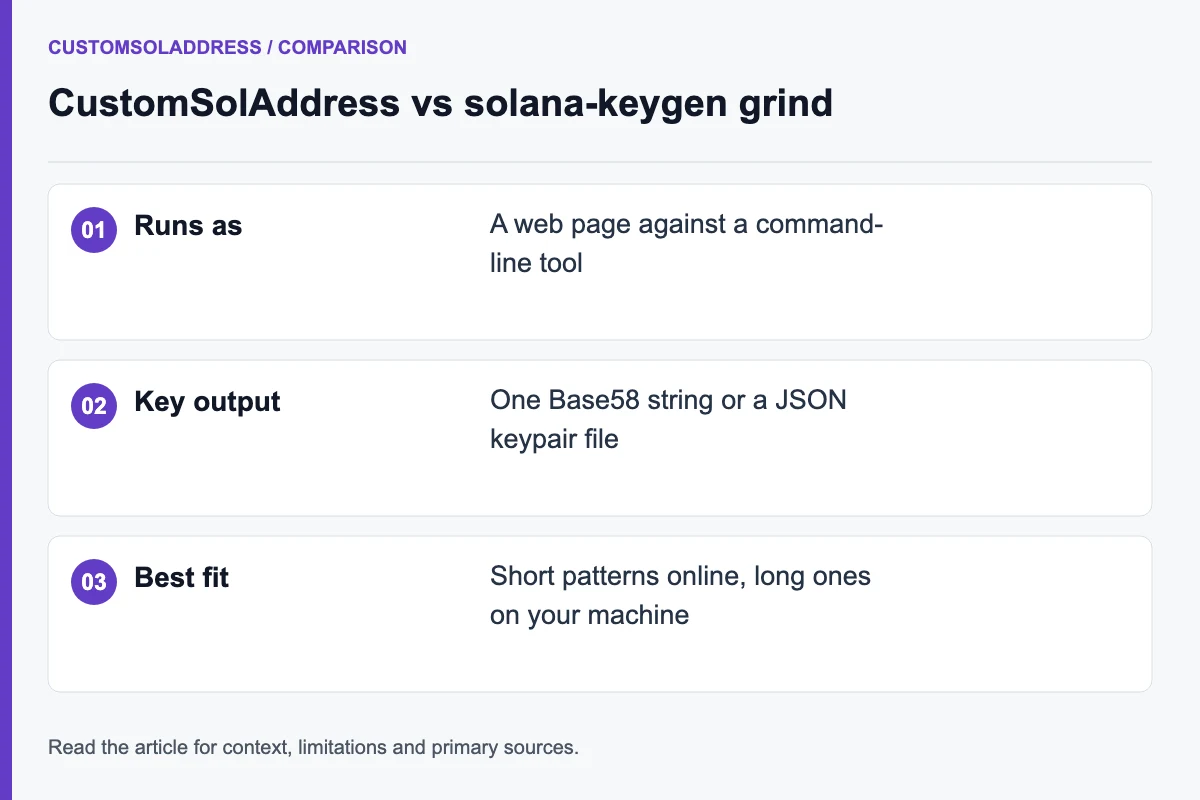
CustomSolAddress and solana-keygen grind at a glance
The two tools do the same core job: they create random keypairs until the Base58 address matches your pattern, then give you the address and its secret key. They differ on how you run them, how long a pattern can be and what the key looks like when you get it.
| CustomSolAddress | solana-keygen grind | |
|---|---|---|
| Price | Free | Free |
| Runs as | Web page | Command-line tool in the Solana CLI tools (Agave) |
| Setup | None | Install the Solana CLI tools: install script, prebuilt binaries, Homebrew or source |
| Pattern position | Prefix or suffix | Prefix, suffix, or both in one search |
| Longest pattern | 6 Base58 characters | No fixed limit; search time is the limit |
| Matches per search | One | A count you set for each pattern, such as sol:4 |
| Letter case | Ignored by default; Match Case option for exact case | Exact case by default; --ignore-case option |
| Key output | Secret key as one Base58 string (64 bytes) | Keypair file named after the address: a JSON array of 64 numbers |
| Seed phrase option | No | Yes, with --use-mnemonic |
| Difficulty planning | Example preview, built-in estimate and a separate difficulty calculator | A progress line every million keypairs searched |
| Source code | Public repository on GitHub | Open source, Apache 2.0 license (anza-xyz/agave) |
Pattern rules and length limits
Both tools accept only Base58 characters: digits 1 to 9 and letters, without 0, O, I or lowercase l. solana-keygen grind decodes each pattern as Base58 and refuses one that does not decode, and CustomSolAddress removes those characters as you type. The address format page lists the rules in one place.
CustomSolAddress searches one prefix or one suffix of up to 6 characters, which keeps a search practical in a web page. solana-keygen grind takes --starts-with PREFIX:COUNT, --ends-with SUFFIX:COUNT or --starts-and-ends-with PREFIX:SUFFIX:COUNT, accepts several of them in one run and sets no length limit of its own.
Letter case works the same way in both when it is ignored: the pattern and the address are compared in lowercase, so a letter that exists in both cases is twice as easy to match. The difference is the default. CustomSolAddress ignores case unless you tick Match Case; solana-keygen grind matches exact case unless you add --ignore-case.
How long does each search take?
Difficulty depends on the pattern, not on the tool. With exact case, each Base58 character multiplies the average work by 58. Ignoring case, each letter that exists in both cases multiplies it by 29; digits and the single-case letters i, o and L stay at 58. Real speed depends on your hardware: solana-keygen grind uses one thread per CPU core by default, which you can change with --num-threads.
- For a prefix, the first character matters too: most addresses start with 2 to 9 or A to H, so a prefix starting with one of those is quicker, and one starting with K to Z or a lowercase letter is much slower. solana-keygen grind's source code uses the same fact to skip keys that cannot match such a prefix.
- The difficulty calculator shows the average time and the 50%, 90% and 99% odds for your own pattern and speed.
| Pattern length | Average attempts, exact case | Average attempts, case ignored, all two-case letters |
|---|---|---|
| 4 | 11,316,496 | 707,281 |
| 5 | 656,356,768 | 20,511,149 |
| 6 | 38,068,692,544 | 594,823,321 |
| 7 (solana-keygen grind only) | 2,207,984,167,552 | 17,249,876,309 |
Key output and wallet import
CustomSolAddress shows the address and its secret key as one Base58 string. That string encodes 64 bytes, the 32-byte private seed followed by the 32-byte public key, and it is what Phantom and Solflare accept as a private key. The import steps in the guide cover each wallet.
solana-keygen grind writes each match to a file named after the address, such as the address followed by .json, in the folder where you ran it. The file holds the same 64 bytes as a JSON array of numbers, the format the Solana CLI reads as a file system wallet. Anza's documentation describes these files as unencrypted and the least secure way to store SOL, so move the key to a wallet and keep the file offline.
With --use-mnemonic, grind derives each key from a new seed phrase and prints that phrase for every match; the help text warns that this mode is significantly slower. A seed phrase is easier to back up on paper than a long key. CustomSolAddress does not produce a seed phrase.
Whichever tool you use, save the key before closing the page or terminal, import it, compare the full address character by character and send a small test amount first.
Running without a connection
solana-keygen grind creates and checks keys on your own computer and needs no network connection for the search, so after installing the Solana CLI tools you can run it on a computer that stays offline. CustomSolAddress is a web page and does not offer an offline build. If an air-gapped search matters to you, that is a reason to choose solana-keygen grind.
Where btc-vanity fits
btc-vanity is an open-source Rust command-line tool that also searches Solana addresses when built with its solana feature. Its README documents prefix, suffix, anywhere and regex searches, a --case-sensitive flag and an experimental GPU backend. It suits a pattern in the middle of the address or a regex, which neither CustomSolAddress nor solana-keygen grind supports.
Which one should you use?
If you are unsure, start with a 3 or 4 character pattern and check the estimate first. A pattern that finishes in seconds in one tool finishes in seconds in the other.
| You need | Better fit | Why |
|---|---|---|
| A short prefix or suffix with nothing to install | CustomSolAddress | Web page with an example preview and a built-in estimate |
| A pattern of 7 or more characters | solana-keygen grind | No fixed length limit and native multithreaded speed |
| A prefix and a suffix at the same time | solana-keygen grind | --starts-and-ends-with in one search |
| Several matching keys in one run | solana-keygen grind | A count for each pattern |
| A seed phrase for the new address | solana-keygen grind | --use-mnemonic prints one for every match |
| An offline or air-gapped search | solana-keygen grind | Runs on your own computer after install |
| A pattern anywhere in the address, or a regex | btc-vanity | Anywhere and regex search modes |
Frequently asked questions
Is solana-keygen grind an official tool?
It is part of the Solana CLI tools that Anza maintains in the open-source Agave repository, and it is installed together with the solana command. CustomSolAddress is an independent web generator.
Do both produce the same kind of address?
Yes. Both return a standard Ed25519 keypair whose public key is the Solana address. You can use it as a wallet, or as the keypair for a token mint or a program ID; the account types guide explains each case.
Which one is faster?
Speed depends mostly on your hardware, and every Base58 character multiplies the work by about 58 in both tools. For long patterns, a native command-line tool such as solana-keygen grind running on all CPU cores is usually faster than a web page.
Sources and editorial method
The technical references below support the concepts discussed in this article. Examples and comparison worksheets are explanatory, not measured service benchmarks.
Read next
Pattern choice8 min read
Custom Solana Address Ideas: Valid Prefixes, Suffixes and Fallbacks
Build a shortlist of valid Solana address patterns, compare prefix and suffix visibility, and choose a shorter fallback before generation.
Pattern choice8 min read
Solana Address Prefix or Suffix: Which Placement Gets Seen?
Choose between a prefix and a suffix for a custom Solana address: where wallets and explorers truncate, what each costs, and when to combine.
Developers7 min read
Custom Solana Program ID: Deploy With a Vanity Keypair
Give a Solana program a recognizable ID: deploy with --program-id, set declare_id! in Anchor, sync keys and separate upgrade authority.
Comparison7 min read
.sol Domain vs Custom Solana Address: Which Do You Need?
Compare a .sol domain from Solana Name Service with a custom vanity address: what each changes, pricing, wallet support and using both.