Account types
Solana Wallet vs Token Mint vs Program Address: Which Can Be Custom?
How Solana wallet addresses, token mints, token accounts, program IDs and PDAs differ, and which ones can carry a custom pattern.
One address format, many account roles
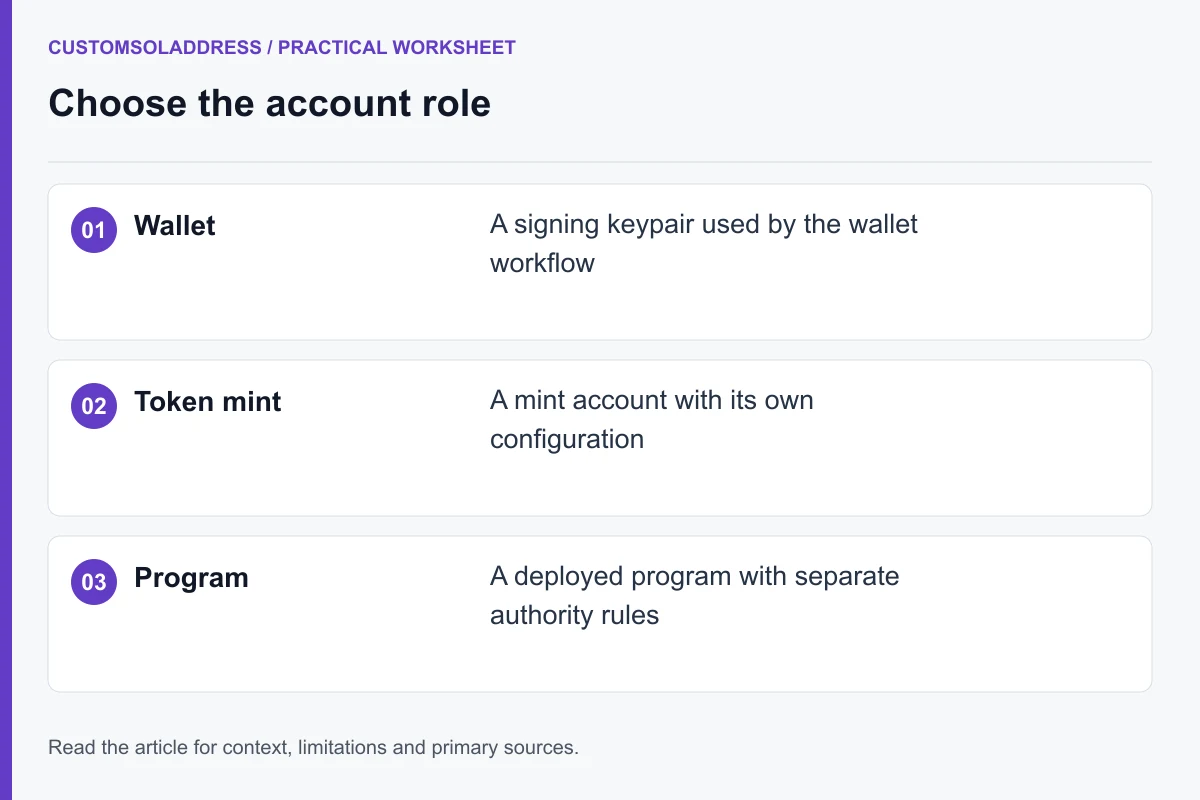
On Solana everything is an account, and every account is located by a 32-byte address shown as 32 to 44 Base58 characters. Looking at the string alone, you cannot tell a wallet from a token mint or a program: the format is identical. What differs is the data stored in the account and, above all, which program owns it.
This matters when someone asks for a custom Solana address. A pattern on a wallet address changes what people see in transfers; a pattern on a mint changes what people see on token pages; a pattern on a program ID changes what developers see in logs and explorers. The workflow, tooling and risks are different for each, so name the role before choosing a pattern. The CustomSolAddress keypair generator produces the keypair; what that address becomes depends on how you use it.
The five account types you will meet
The table lists the account types that come up most often when choosing a custom address, how each is created, and whether its address can be chosen by searching for a matching keypair. Program addresses for the classic Token program, Token-2022 and the System Program are fixed, well-known values. The Solana address guide on account types summarizes the same choice.
| Account type | Owner program | How its address is created | Custom pattern possible? |
|---|---|---|---|
| Wallet (system account) | System Program 11111111111111111111111111111111 | Public key of an Ed25519 keypair | Yes, from a matching keypair |
| Token mint | Token program TokenkegQfeZyiNwAJbNbGKPFXCWuBvf9Ss623VQ5DA or Token-2022 TokenzQdBNbLqP5VEhdkAS6EPFLC1PHnBqCXEpPxuEb | Keypair that signs the create-mint transaction | Yes, pass the keypair to spl-token create-token |
| Associated token account | Token program | Derived from wallet, token program and mint | No, it is deterministic |
| Auxiliary token account | Token program | Keypair passed to spl-token create-account | Yes, but rarely useful |
| Program (program ID) | A BPF loader, usually the upgradeable loader | Keypair used on first deploy | Yes, pass it with --program-id |
| Program derived address (PDA) | Whatever program uses it | Hash of seeds plus program ID, off the curve | Only by searching seeds; no private key exists |
Wallet addresses: the keypair is the identity
A wallet address is the public half of an Ed25519 keypair. The account it points to is owned by the System Program and holds SOL; it has no data. Whoever holds the private key can sign transfers from it. A custom wallet address is therefore simply a keypair whose public key happens to match a pattern, and it behaves exactly like any other wallet once imported.
A wallet address does not hold SPL tokens directly. When someone sends you USDC, the tokens go to a token account linked to your wallet. That is why explorers show a separate token-holdings tab and why a single wallet can have dozens of associated token accounts, each with its own address.
Token mints and token accounts are different addresses
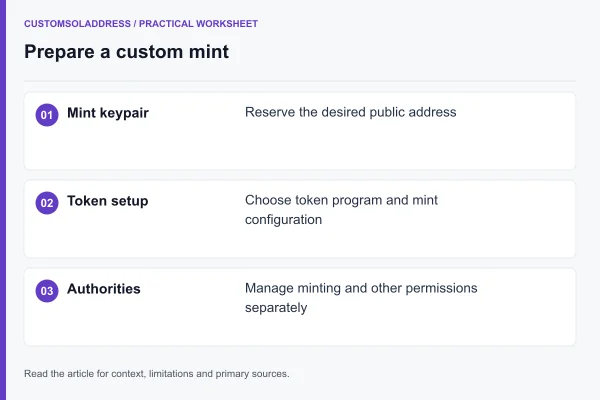
A mint account defines a token: its supply, decimals, mint authority and optional freeze authority. Its address is the token's identity, the string listed on DEXs, aggregators and token pages. A mint is created by a keypair that signs the initialization, so a custom mint address is possible and common; creating a custom token mint address walks through it with spl-token.
A token account holds a balance of one mint for one owner. The usual kind, the associated token account, has an address derived from the owner's wallet, the token program and the mint, so every wallet has exactly one predictable ATA per mint. Because it is derived, nobody can give an ATA a custom pattern. When you enter a recipient's wallet address, wallets send the tokens to that wallet's associated token account, creating it if needed; entering a mint address as the recipient is a classic mistake.
Program IDs and program derived addresses
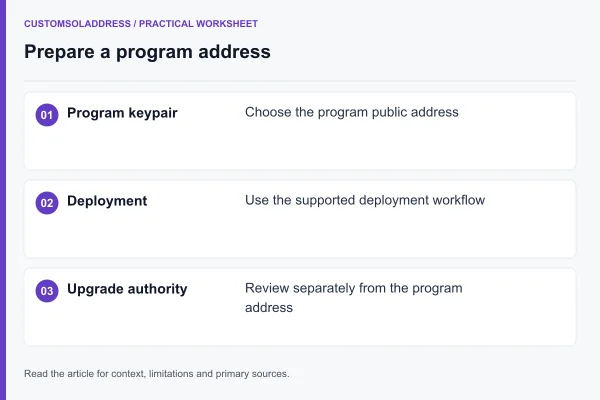
A program is an account with the executable flag set. Its address, the program ID, comes from the keypair used on the first deployment, and after that the upgrade authority, not the program keypair, controls changes. Developers who want a recognizable program ID search for a matching keypair before the first deploy; choosing a custom program ID covers solana program deploy and Anchor.
A program derived address is computed from seeds and a program ID with SHA-256 and a bump value so that the result falls off the Ed25519 curve. No private key exists for it; only the program can sign for it via invoke_signed. You cannot import a PDA into a wallet. A pattern on a PDA is possible only by trying different seeds, which changes the seeds your program must use forever.
How to identify an address type on-chain
The owner field answers the question. Run solana account against the address, or open it in Solana Explorer or Solscan, which label the account type. The output below shows the System Program itself, an executable account owned by the native loader. A normal wallet shows Owner: 11111111111111111111111111111111 and Executable: false; a mint or token account shows a Token program as owner, and spl-token display decodes which of the two it is.
- Owner is the System Program and no data: a wallet that can receive SOL and own token accounts.
- Owner is a Token program and spl-token display says Mint: a token definition, not a place to send tokens.
- Owner is a Token program and display says Account: a token balance with its own wallet owner.
- Executable is true: a program; do not send funds to it.
- Address is off-curve: a PDA controlled by a program.
$ solana account 11111111111111111111111111111111 --url devnet
Public Key: 11111111111111111111111111111111
Balance: 0.000000001 SOL
Owner: NativeLoader1111111111111111111111111111111
Executable: true

# Decode a token-program account (mint, token account or multisig)
$ spl-token display <ADDRESS>
Choosing which address to customize
For a personal or treasury identity, customize the wallet address. For a token brand, customize the mint, since that string appears wherever the token is listed. For a protocol, customize the program ID. Customizing all three is possible but each needs its own keypair search, and each keypair has a different security lifetime: a wallet key must be protected forever, while mint and program keypairs only matter until the account is created.
Whatever you choose, plan the pattern with the prefix or suffix guide and remember that recipients still need to compare full addresses, as explained in verifying an address before sending.
A practical sequence for a new project is to customize the program ID first if you build one, since it must exist before the first deploy, then the token mint before launch, and finally the treasury wallet. Each is an independent keypair search, so the patterns can share a theme, for example the same ticker as a suffix on the mint and a prefix on the treasury, without depending on each other.
Continue the practical setup
- Custom Solana Token Mint Address: Create a Branded Mint — Use a pre-generated keypair as your SPL token mint with spl-token create-token, for Token or Token-2022, plus metadata and mint authority.
- Custom Solana Program ID: Deploy With a Vanity Keypair — Give a Solana program a recognizable ID: deploy with --program-id, set declare_id! in Anchor, sync keys and separate upgrade authority.
- Open the complete workflow guide to place these checks in order.
- Open the address generator when you have chosen a compatible format and pattern.
Frequently asked questions
Is a Solana token address the same as a wallet address?
No. The token address people share is the mint address, which defines the token. Balances live in token accounts owned by wallets. A wallet address is the owner of those token accounts and holds SOL directly.
Can I send tokens to a mint address?
You should not. A mint is not a holder. If a wallet treats the mint address as a recipient, the tokens land in a token account controlled by whoever holds that address's key, or by nobody for program-controlled addresses. Always send to the recipient's wallet address.
Can an associated token account have a vanity address?
No. Its address is derived from the owner wallet, the token program and the mint, so it is fixed once those three are chosen. You can only influence it indirectly by choosing the wallet or mint.
How do I tell a PDA from a wallet address?
A PDA is off the Ed25519 curve. In @solana/web3.js, PublicKey.isOnCurve returns false for a PDA and true for a normal wallet public key. Explorers also label PDAs by the program that owns their data.
Which address should a project customize first?
Usually the program ID if you deploy one, because it must exist before the first deploy, then the token mint before launch. Wallet addresses can be customized at any time by creating a new keypair.
Sources and editorial method
The technical references below support the concepts discussed in this article. Examples and comparison worksheets are explanatory, not measured service benchmarks.
Read next
Tokens7 min read
Custom Solana Token Mint Address: Create a Branded Mint
Use a pre-generated keypair as your SPL token mint with spl-token create-token, for Token or Token-2022, plus metadata and mint authority.
Developers7 min read
Custom Solana Program ID: Deploy With a Vanity Keypair
Give a Solana program a recognizable ID: deploy with --program-id, set declare_id! in Anchor, sync keys and separate upgrade authority.
Comparison7 min read
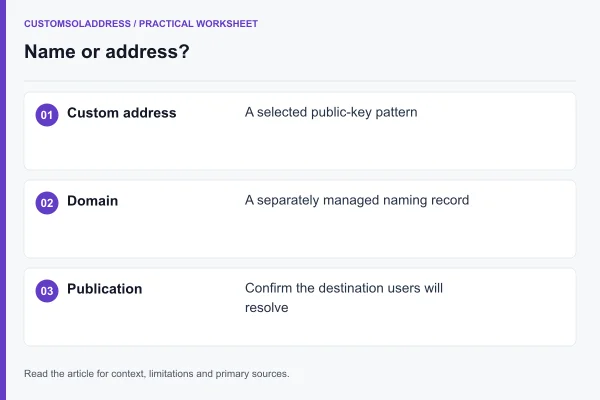
.sol Domain vs Custom Solana Address: Which Do You Need?
Compare a .sol domain from Solana Name Service with a custom vanity address: what each changes, pricing, wallet support and using both.
Comparison6 min read
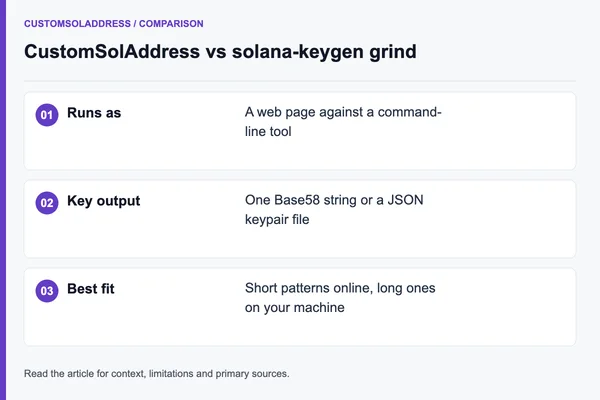
CustomSolAddress vs solana-keygen grind: Pattern Rules, Key Output and Which to Use
CustomSolAddress vs solana-keygen grind: pattern rules, length limits, letter case, keypair files, seed phrases and offline use, plus where btc-vanity fits.