
Pattern choice
Solana Address Prefix or Suffix: Which Placement Gets Seen?
Choose between a prefix and a suffix for a custom Solana address: where wallets and explorers truncate, what each costs, and when to combine.
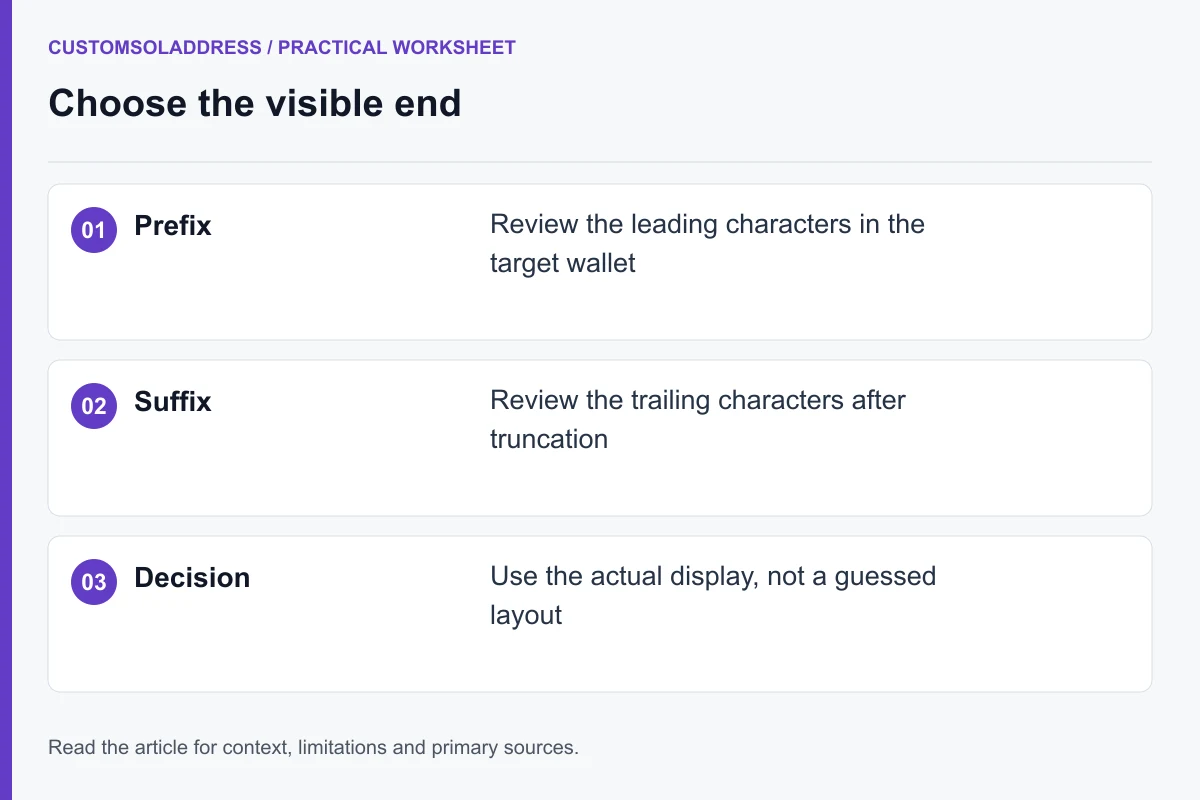
Where a Solana address is actually displayed
A Solana address is usually 43 or 44 characters long, which is too wide for a wallet balance row, a transaction list or a token card on a phone screen. Interfaces therefore abbreviate it, typically keeping a handful of characters from the start and the end and replacing the middle with an ellipsis. A display like 7xKp...Wx3k is the common shape; the exact count varies by app and screen size, and some views show five or six characters at each end.
Because the abbreviation keeps both ends, prefixes and suffixes are both visible in most compact views. The characters in the middle of the address are almost never shown outside a detail page or a copy dialog. That is why custom address patterns are placed at the start or end and practically never in the middle: a middle pattern costs as much to find but nobody sees it.
Before deciding, open the screens your users will really use: the wallet they hold, the explorer you link to (Solana Explorer or Solscan), your own dashboard, and any exchange deposit page. Count how many characters each one shows at the start and at the end. That number is the useful upper bound for your pattern length in that placement. Then try both placements in the custom Solana address generator with a short test pattern.
Which end matters in each context
Different readers look at different ends of the string. People scanning a list read left to right and register the first characters first, so a prefix tends to be noticed earlier. People confirming a transfer are often trained to check the last characters, so a suffix tends to be what they compare. The table summarizes typical contexts; confirm each against the actual interface you rely on. The display notes in the custom Solana address guide cover the same trade-off in brief.
| Context | What is usually visible | Placement that tends to stand out |
|---|---|---|
| Wallet account header or switcher | Account name plus a short abbreviated address | Prefix, because it is read first |
| Transaction history rows | Leading and trailing characters of the counterparty | Either; users often compare the ending |
| Explorer tables (Solscan, Solana Explorer) | Abbreviated address or full address depending on column width | Prefix in narrow columns |
| Token pages and DEX listings | Mint address abbreviated next to the ticker | Suffix is common for token mints |
| Printed material, QR captions, slides | Full address or a deliberate excerpt | Prefix, since readers start on the left |
How prefix, suffix and combined patterns compare in cost
A Solana address is the Base58 encoding of a 32-byte public key, and a generator finds a pattern by creating random keypairs until one matches. Each additional case-sensitive character multiplies the expected number of attempts by roughly 58, the size of the Base58 alphabet. A four-character pattern is therefore about 58 times more work than a three-character one, regardless of which end it sits on.
A suffix of N characters costs about the same whatever the characters are, because the last positions of an address are evenly distributed. The first position is not. About 94 percent of addresses are 44 characters long, and a 44-character address can only start with 2 through 9, A through H, or occasionally J. In a random sample of 300,000 Base58-encoded 32-byte keys, each of 2 to H led about 5.9 percent of the time, while each of K to Z and a to z led only about 0.1 percent of the time.
The practical consequence: a prefix whose first letter is between 2 and H is several times cheaper than average, and a prefix starting with N, S, T, lowercase letters or most of the late alphabet is far more expensive than the same characters as a suffix. Nova as a prefix is a slow search; Nova as a suffix, or a prefix like DAo or Gm, is ordinary.
Requiring a prefix and a suffix at the same time multiplies their costs. A three-character prefix plus a three-character suffix is as expensive as a six-character prefix, not as a three-character one. For the reasons this happens and the arithmetic behind it, see the dedicated difficulty references linked from our custom address guide; this article stays with the choice itself.
- Prefix of N characters: about 58 to the power N attempts on average for an exact-case match.
- Suffix of N characters: the same order of magnitude as a prefix of N characters.
- Prefix of A plus suffix of B characters: about the same as a single pattern of A + B characters.
- Case-insensitive matching: cheaper, because several characters satisfy each position, but the visible result may mix cases.
Worked examples of placement decisions
A project treasury that appears in governance dashboards and multisig lists usually benefits from a prefix such as DAo or Fund, because those screens show the start of the address next to a label. A suffix would be visible but competes with the label for attention.
A token mint is often recognized from its ending in DEX search results and token pages, which is why token communities frequently use suffixes. The custom token mint address guide covers how a selected keypair becomes a mint with spl-token.
A payment address printed on an invoice or a donation page is read from the left, so a short prefix is the most legible choice; one that starts with a character from 2 to 9 or A to H, such as Buy or a store initial like C, keeps the search ordinary. Keep it short enough that readers still check the rest of the address.
A program ID is mostly read by developers in logs, IDLs and explorer pages, where the full string appears. A short prefix is enough for quick recognition in log output; see choosing a custom program ID for the deployment details.
When a prefix and a suffix together make sense
Combining both ends is attractive when an interface shows exactly four characters at each side, because a matching start and end would fill the whole visible abbreviation. The cost is that two short patterns add up to one long one. Two characters at each end are about as hard to find as one four-character prefix, which is usually manageable; four at each end is equivalent to an eight-character pattern, which is far harder.
Filling both visible ends also has a security side effect worth understanding. Address-poisoning attackers already generate addresses that match the first and last few characters of a target. A recognizable pattern helps your own users notice your address, but it never proves the address is yours, and users must still compare the full string, as explained in how to verify a Solana address before sending.
A short checklist before you commit
Write down the decision so another person can reproduce it. Include the placement, the exact characters with their case, whether case-insensitive matches are acceptable, and which screens justified the choice. Confirm every character belongs to the Base58 alphabet using the Base58 character reference before you start any search.
Real addresses come from tools that create keypairs locally, such as solana-keygen.
- Placement: prefix, suffix, or both, with the screens that justify it.
- Pattern: exact characters and case, checked against Base58.
- Length: no longer than the characters your key screens display.
- Purpose: wallet, token mint, program ID or treasury.
- Verification rule: full-address comparison remains mandatory.
Continue the practical setup
- Solana Address Pattern Ideas: Readable, Brandable, Valid — Pattern ideas for a custom Solana address that stay inside Base58: names, tickers, numbers and substitutions, realistic lengths, and patterns to avoid.
- Solana Base58 Characters: Why 0, O, I and l Are Rejected — The Base58 alphabet used by Solana addresses, the four excluded characters, valid substitutions for common words and the errors they cause.
- Open the complete workflow guide to place these checks in order.
- Open the address generator when you have chosen a compatible format and pattern.
Frequently asked questions
Is a Solana prefix harder to get than a suffix?
It depends on the first character. Suffixes cost about the same for any characters. Prefixes starting with 2 to 9 or A to H are cheaper than average, while prefixes starting with K to Z or any lowercase letter are much rarer, because most addresses are 44 characters long and those can only begin with the lower part of the alphabet.
How many characters do wallets show?
It varies by wallet, screen and column width. Many compact views keep about four characters on each side of an ellipsis. Check the specific wallet and explorer your audience uses rather than assuming a number.
Can I put the pattern in the middle of a Solana address?
A generator can search for it, but compact views hide the middle, so the pattern would rarely be seen. It costs as much as a prefix of the same length without the visibility benefit.
Does a matching prefix prove an address belongs to someone?
No. Attackers can generate addresses with the same first and last characters. Use the pattern for recognition only and compare the full address, as described in our guide on verifying an address before sending.
Sources and editorial method
The technical references below support the concepts discussed in this article. Examples and comparison worksheets are explanatory, not measured service benchmarks.
Read next
Pattern choice8 min read
Custom Solana Address Ideas: Valid Prefixes, Suffixes and Fallbacks
Build a shortlist of valid Solana address patterns, compare prefix and suffix visibility, and choose a shorter fallback before generation.
Troubleshooting7 min read
Solana Base58 Characters: Why 0, O, I and l Are Rejected
The Base58 alphabet used by Solana addresses, the four excluded characters, valid substitutions for common words and the errors they cause.
Security7 min read
Verify a Solana Address Before Sending: Checks That Work
How to verify a Solana address before sending SOL or tokens: compare the full string, spot address poisoning, test transfers, account types.
Comparison6 min read
CustomSolAddress vs solana-keygen grind: Pattern Rules, Key Output and Which to Use
CustomSolAddress vs solana-keygen grind: pattern rules, length limits, letter case, keypair files, seed phrases and offline use, plus where btc-vanity fits.