Comparison
.sol Domain vs Custom Solana Address: Which Do You Need?
Compare a .sol domain from Solana Name Service with a custom vanity address: what each changes, pricing, wallet support and using both.
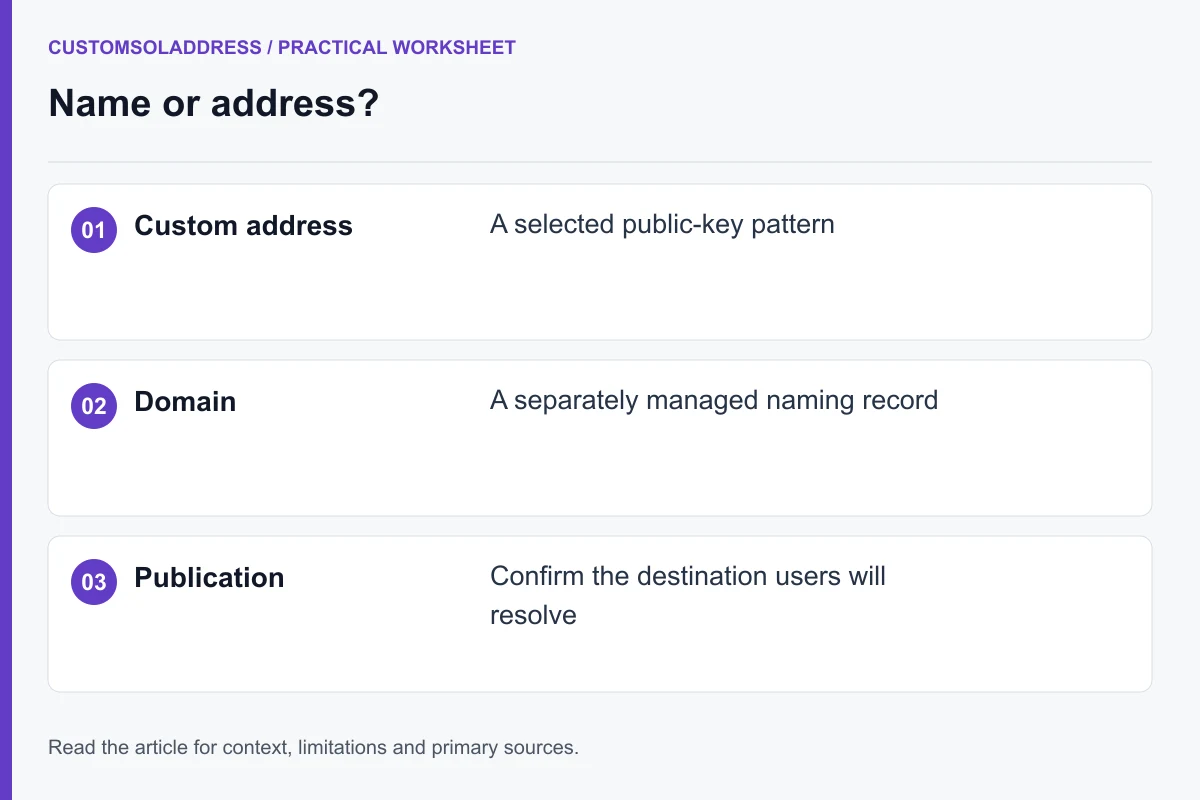
Two different tools that solve different problems
A .sol domain is a name, such as nova.sol, registered on the Solana Name Service (SNS), originally built by Bonfida and now run at sns.id. When someone types the name into a supporting wallet, the wallet looks up the address it points to and sends there. The underlying address does not change.
A custom or vanity address is an ordinary Solana address whose characters happen to match a pattern, such as one beginning with Gm or ending with Nova. Nothing is looked up: the address is the identity, and every wallet, exchange and explorer that accepts Solana addresses accepts it, because it is simply a keypair like any other. You can create one with the free custom Solana address tool.
Both options exist because raw addresses are hard for people. They attack the problem from opposite ends: a domain hides the address behind a name, while a custom address makes part of the address itself memorable. Neither changes how Solana transactions work, how fees are charged or which key controls the funds. The guide to custom Solana address display shows how a pattern appears in shortened views.
Side-by-side comparison
The table compares the two on the points that usually decide the question. Prices are taken from the SNS registration documentation at the time of writing and are paid as the USD equivalent of the token you choose; confirm them on sns.id before buying.
| Aspect | .sol domain (SNS) | Custom Solana address |
|---|---|---|
| What changes | Adds a readable name that resolves to an address | The address characters themselves |
| How users enter it | Type the name in a supporting wallet | Paste or scan the full address |
| Works everywhere | Only where SNS resolution is integrated | Anywhere a Solana address is accepted |
| Cost | From 20 USD for 5+ character names up to 750 USD for 1 character | Computation to find a keypair; no registry fee |
| Can be transferred | Yes, the domain can be sold or moved to another wallet | Only by moving funds to a new address; the key is the address |
| Lookup risk | Name can be repointed or transferred later | None, but look-alike addresses can be generated |
| Private key implications | Domain is controlled by the owner wallet's key | The custom address has its own key that must be protected |
How .sol registration and resolution work
According to the SNS documentation, a newly registered domain is automatically linked to the wallet address that signs the registration transaction, and one wallet can hold an unlimited number of domains. Pricing depends on name length, from 20 USD for names of five or more characters to 750 USD for single-character names. Payment can be made in a token of your choice, with a 5 percent discount when paying in FIDA, or by card through a checkout partner.
Registration has been described by explorer guides such as Solscan's as a one-time purchase without an annual renewal, unlike traditional DNS domains. The SNS registration page itself lists prices without mentioning renewals, so check the current terms on sns.id at purchase time rather than assuming either model. Domains can also be traded on a secondary market, which means a name you see today may belong to someone else tomorrow.
Because the domain is controlled by the key of the wallet that owns it, losing that key also means losing control of the name. Treat the owning wallet with the same care as any wallet that holds funds.
Wallet and app support
SNS publishes a list of integrations. Its wallets section names Phantom, Solflare, Backpack, Trust Wallet, MetaMask, Coin98, MathWallet and several others, and explorers can display domains next to addresses. Support differs by feature: some apps resolve names when sending, others only show a domain as a label on an address.
A custom address needs no integration at all. Exchanges in particular usually require a raw address for withdrawals, so a domain alone may not help users sending from an exchange, while a recognizable address still appears in the withdrawal confirmation screen.
Risks specific to each option
A domain introduces indirection. If the owner transfers the domain, lets someone else control it, or changes where it points, payments sent to the name go to the new destination. Look-alike names, such as an extra letter or a different suffix, are another phishing route. Always look at the resolved address in the confirmation screen before signing.
A custom address has its own risks. Attackers can generate addresses that share your visible prefix and suffix, which is the core of address poisoning, and the private key of a vanity wallet must have been generated locally by a tool you trust. Our guide to verifying a Solana address before sending applies to both cases.
- Domain: check the resolved address, not only the name.
- Domain: be aware the name may change ownership on the secondary market.
- Custom address: compare the full string, not only the pattern.
Which one fits your situation
Individuals who mainly receive payments from friends using mainstream wallets get the most from a domain: telling someone to send to a short name is easier than any address, and popular wallets resolve it. A custom address adds little for them unless they enjoy the look of it.
Projects, treasuries and token issuers usually benefit from a custom address, because their address appears in places no name service reaches: exchange withdrawal confirmations, explorer transaction lists, governance proposals, block explorers' token pages and audit reports. A token's mint address in particular cannot be replaced by a domain at all, which is why custom token mint addresses are a separate topic.
Developers sometimes ask whether a domain can stand in for a program ID. It cannot: programs are invoked by their address in every instruction, so the recognizable string has to be the address itself, as covered in choosing a custom program ID.
- Personal receiving address: a .sol domain first, a custom address optional.
- Project treasury or donation wallet: a custom address, plus a domain for convenience.
- Token mint: only a custom address applies.
- Program ID: only a custom address applies.
Using a domain and a custom address together
The combination is often the most practical. Register the domain to the custom address wallet so that people can type the name, and when the wallet shows the resolved address in the confirmation step, the recognizable pattern gives a second visual cue that the name points where you intended. Publish both the name and the full address on your website.
If you go this route, decide the pattern first with the prefix or suffix guide and brainstorm with Solana address pattern ideas, create the wallet, then register the domain from that wallet so it links automatically.
Continue the practical setup
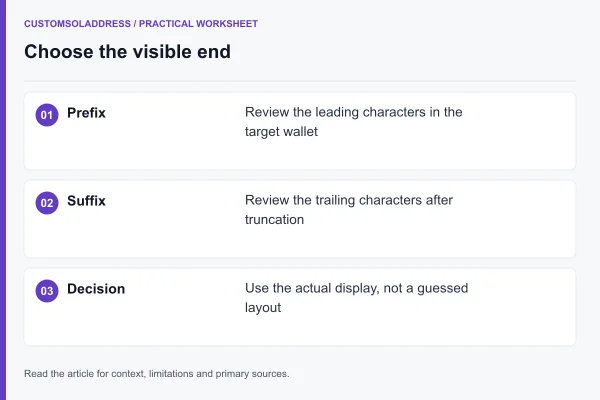
- Solana Address Prefix or Suffix: Which Placement Gets Seen? — Choose between a prefix and a suffix for a custom Solana address: where wallets and explorers truncate, what each costs, and when to combine.
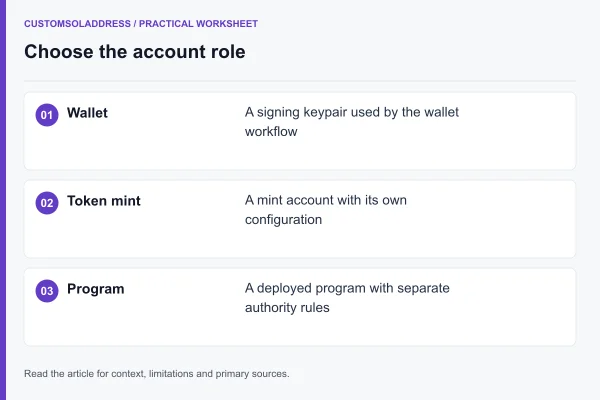
- Solana Wallet vs Token Mint vs Program Address: Which Can Be Custom? — How Solana wallet addresses, token mints, token accounts, program IDs and PDAs differ, and which ones can carry a custom pattern.
- Open the complete workflow guide to place these checks in order.
- Open the address generator when you have chosen a compatible format and pattern.
Frequently asked questions
Is a .sol domain the same as a vanity address?
No. A .sol domain is a name stored on Solana Name Service that points to an address. A vanity address is an address whose characters match a pattern. You can have either one, or both.
How much does a .sol domain cost?
The SNS documentation lists prices by length, from 20 USD for five or more characters to 750 USD for a single character, payable as the USD equivalent of your chosen token. Check sns.id for current prices.
Do .sol domains expire?
Explorer guides describe SNS registration as a one-time purchase with no annual renewal. The SNS documentation does not state a renewal fee, but verify current terms on sns.id before relying on it.
Can I send SOL to a .sol domain from any wallet?
Only from wallets and apps that integrate SNS resolution, such as those listed on the SNS integrations page. Exchanges typically require the raw address.
Can I point a .sol domain at a custom address?
Yes. Register the domain from the custom address wallet and SNS links it to that wallet automatically. Wallets that resolve the name will then show your recognizable address in the confirmation screen.
Sources and editorial method
The technical references below support the concepts discussed in this article. Examples and comparison worksheets are explanatory, not measured service benchmarks.
Read next
Pattern choice8 min read
Solana Address Prefix or Suffix: Which Placement Gets Seen?
Choose between a prefix and a suffix for a custom Solana address: where wallets and explorers truncate, what each costs, and when to combine.
Account types7 min read
Solana Wallet vs Token Mint vs Program Address: Which Can Be Custom?
How Solana wallet addresses, token mints, token accounts, program IDs and PDAs differ, and which ones can carry a custom pattern.
Publishing an address3 min read
Review a Solana Address QR Code Before Publishing
Check the encoded value, visible address and destination context when a Solana address is presented as a QR code.
Comparison6 min read
CustomSolAddress vs solana-keygen grind: Pattern Rules, Key Output and Which to Use
CustomSolAddress vs solana-keygen grind: pattern rules, length limits, letter case, keypair files, seed phrases and offline use, plus where btc-vanity fits.